



Description
Spectacular facsimile edition of the Book of Hours of Catherine of Cleves, the original manuscript of which is preserved in New York, The Morgan Library & Museum, Ms. M.917/945.
Edition produced by Faksimile Verlag in 2009, numbered and limited to 980 copies.
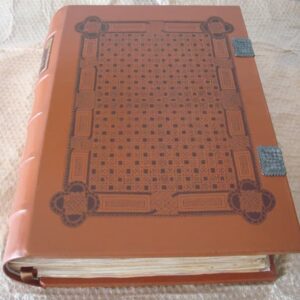
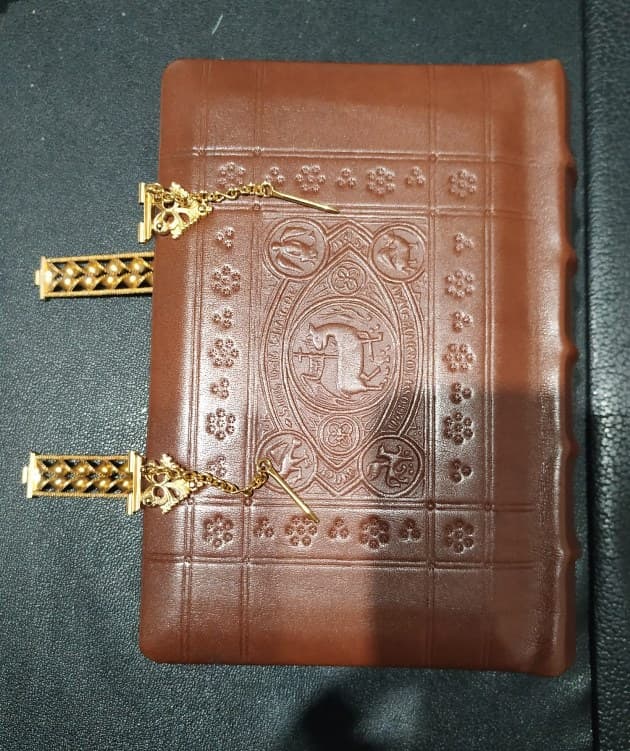
Facsimile bound in brown leather with blind engraving, featuring two gilt clasps and a red stone inlaid in the cover. The binding reproduces a historical book from Utrecht after 1480.
It is presented in a methacrylate display with a recessed support for the endpaper of the complementary study book with texts in English and German by Rob Dückers, Eberhard König, Anne Korteweg, James Marrow, William Voelke, and Roger Wieck.
The greatest Dutch master of book illumination created this magnificent Book of Hours around 1430. The detailed illustrations of 15th-century everyday life are unique in their form and content. Artists from Utrecht, or perhaps also Nijmegen, created a wonderful Book of Hours for the Duchess of Guelders, a book that, in both volume and quality, is unparalleled, even in the later period of book painting.
Catherine of Cleves, granddaughter of John the Bold, Duke of Burgundy, was the recipient for whom the eponymous master decorated this handwritten book with 157 miniatures in an extremely practical format. The high quality of the work and its enormous iconographic variety lead us to assume that the Master of Catherine of Cleves must have been familiar with the art of the van Eyck brothers and the French illumination of his time.
On the other hand, he developed his own unmistakable style that would influence later illuminators, not only in the Netherlands. Neither Willem Vrelant nor the Master of Mary of Burgundy would be conceivable without this great Dutch book painter.
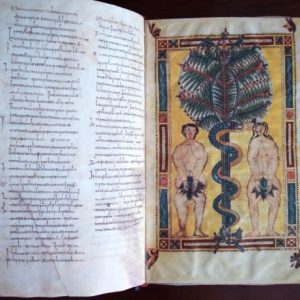
A book as a picture gallery: 157 half- and full-page miniatures in opulent frames make the Hours of Catherine of Cleves the largest coherent picture gallery in 15th-century Dutch art. Many of these paintings are not only extraordinary in form and content, but also unique in the strictest sense of the word: nowhere else in late medieval art do we find parallels or correspondences with this work.
An image that represents everyday life in the 15th century is that of the Holy Family, in which the Child Jesus is seen learning to walk with his tacataca (or tacatá). An image that speaks volumes about this extraordinary Book of Hours.
Some of the impressive depictions, such as Purgatory and Hell, anticipate themes from Bosch’s works. We even discover elements that hint at Dutch genre painting of later centuries. The small paintings, richly detailed and elaborately executed, transport us to the world of the period around 1430. With colors that still shine today, we discover the real life and family surroundings of the people of the time. To achieve his goal, the master used biblical events and scenes from the lives of saints.
However, images were not the only means with which the Master of Catherine of Cleves sought to depict a courtly, bourgeois, and rural setting. He also placed special emphasis on the space surrounding the miniatures. The page margins are decorated with coins, mussels and crabs, fighting cocks, fish, butterflies, flowers, and insects of all kinds. Birdcages and fish traps also form elaborate frames where we also find images of hunting and fishing, a farmer’s wife milking, or an entire bakery. The list could go on indefinitely. It must have been a true pleasure for the duchess to discover ever-new scenes during her moments of prayer. In fact, the margins are like a book within the book, giving this Book of Hours a particular joy, for example, on the page where Saint Bartholomew appears framed with freshly baked cakes and crispy pretzels.
Although it is unknown who commissioned this sumptuous Book of Hours, we can assume with a fair degree of certainty that it was written, painted, and illustrated for Catherine of Cleves on the occasion of her marriage to Arnold of Egmont, Duke of Guelders. Catherine came from a family whose name was in the same breath as the great princely dynasties of Europe. Her mother was Mary of Burgundy, daughter of John the Bold and wife of Arnold of Cleves. Catherine was an extremely self-confident woman who, supported by Philip the Good, assumed power in Guelders for a time to put an end to her husband’s mismanagement.
This copy is complete and in perfect condition, unused.
Free shipping for this item. Ask us any questions, indicating the article reference.
You can watch a short video about this wonderful work: